


Insights
What Do the 2026 Elections Mean for Business Owners Considering a Sale?
November 16, 2026


The Economic Forces That Could Reshape M&A Activity, Business Valuations, and Exit Timing
The answer to this question will vary by industry, company, and individual circumstances. Much of what is being discussed today is conjecture. In this article, we will stick to the time-proven answers that are universally applicable.
Could a Wave of Business Owners Looking to Exit Push Company Valuations Lower?
Uncertainty is good for the M&A markets in general. More deals get done. But that is primarily because uncertainty moves the supply curve to the right.
Owner-operators who have been on the roller coaster for years usually aren't looking for one more loop-the-loop before the ride ends.
“Enough, I’m not going through this again,” is a popular refrain.
Owners who had been planning on another five to ten years may accelerate their exit plans.
When the supply curve moves right, and the demand curve stays put, we get more deals at lower prices and valuation multiples.
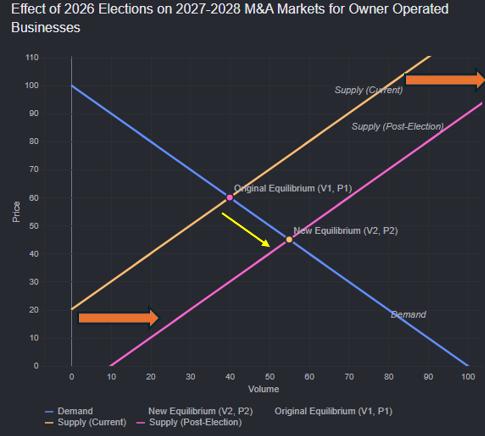
But this does not happen overnight. The supply curve shifts gradually.
Some owners take the wait-and-see approach, preferring to believe it when they see it rather than start the sale process the day after the election. Then, of course, it takes time to get to market.
Some will wait for year-end numbers to be completed, maybe even for taxes to be filed or audits completed. All the while, the yellow line above shifts to the purple line. We expect deal volume to start increasing in Q1 2027, with a lag of two to three quarters before prices begin to decline.
The move is, of course, not linear. Rather, there is a saturation point, or tipping point, when it becomes clear to everyone that current supply exceeds current demand. Once that happens, downward pricing pressure can accelerate.
We expect 2027 to be a particularly active year for M&A transactions, while the more significant consequences for valuation multiples may emerge in the second half of 2027 and extend into 2028.
See Why Business Owners Worldwide Trust Benchmark International
Will the New Political Landscape Bring More Buyers to the Table or Drive Them Away?
When the electorate’s movement supports less business regulation, lower taxes, less emphasis on labor regulation, and the like, the shift in the equilibrium for the supply and demand curves is traditionally mitigated by a rightward shift of the demand curve.
More buyers enter the market. Deal volume still increases, but the downward pressure on prices is less severe, as illustrated below by the movement from the blue line to the pink line.
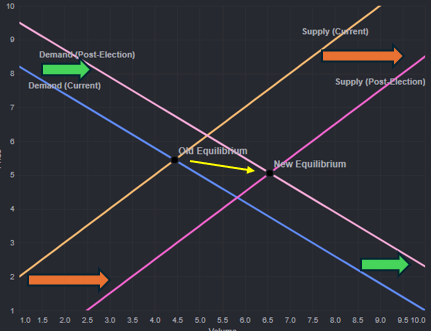
More buyers enter the market for a number of reasons. Perhaps they see the value of the added speed a buy-versus-build strategy can offer. Perhaps their financing sources reload the buyer’s coffers more generously. Perhaps it’s just FOMO. Whatever the motivation, favorable business conditions can bring additional buyers into the market.
Now, when the political winds blow in the opposite direction, the demand curve “contracts,” or shifts left a bit.
Given the M&A industrial complex that has grown over the last 50 years, we see this contraction getting smaller with each leftward shift in government.
Too many people keep their jobs if they buy companies and lose them if they don't. There is simply too much cash chasing deals.
Buyers get picky, deals take longer, but money gets spent, and competitive tension remains for strong companies marketed through well-run sale processes.
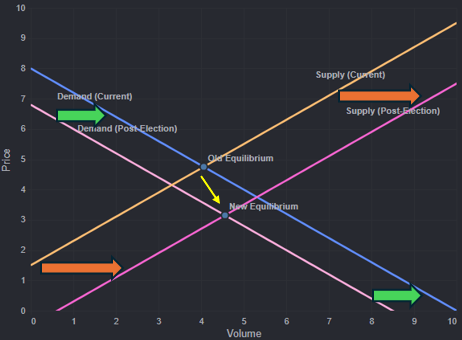
Deal count still goes up, but the downward pressure on values and valuation multiples is magnified. In these cases, we historically see the changes take shape sooner. This is particularly true in years with presidential elections, but less so with midterm elections, such as the one we have just held.
Despite the size of the change in Congress’s composition and the stated aims of some newly elected legislators, a divided government still cannot make changes quickly. This is perhaps even more true the further the left and right are apart on economic policy.
The demand curve here will likely adjust in two stages, starting with a muted contraction that fluctuates as the 2028 presidential prospects ebb and flow, followed by a second adjustment after that election.
Connect with the Team Setting the Global Standard in M&A
How could rising taxes on capital gains, ordinary income, and net investment income impact the after-tax proceeds from selling your business?
Four or five taxes matter when discussing a business sale. All are now potentially in play.
You and I don’t get the same depreciation tax shields available to businesses. Most voters in the last election did not benefit directly from the accelerated depreciation deductions available for qualifying business investments.
Who does? Businesses.
We all heard what the electorate said about corporate tax boondoggles. And let’s not forget that old rule: last in, first out. The most recently enacted benefits can become attractive targets for future tax changes.
Depending on the deal structure, buyers rely heavily on depreciation to allow them to both place high bids and fund those bids with high levels of debt.
When they lose the cash flow provided by the tax shield, in part or in whole, they may no longer be able to offer the same valuation multiples or cash at closing that they have been able to wave around for the last few years.
Partner with the Global Leader in Sell-Side M&A
Then there is the nearly silent, not broadly discussed, and less widely applicable potential change: the end of preferential carried interest treatment.
Many buyers of owner-operated businesses are set up as private equity funds and are structured to take advantage of the carried interest rule.
Without getting into specifics, investment professionals in these funds can receive qualifying compensation taxed at long-term capital gains rates rather than the higher ordinary income rates paid on wages and salaries.
This has been targeted across party lines for some time. But the idea of doing something about it continues to attract attention from both political parties.
The Ending the Carried Interest Loophole Act and the Carried Interest Fairness Act are examples of legislative efforts aimed at changing this treatment.
Given that this is a leading example of a tax-raising measure that both some Republicans and some Democrats have championed, carried interest reform could become an appealing candidate for a bipartisan tax agreement framed around greater fairness.
While this change will not directly affect the seller’s taxes, it could indirectly affect transaction economics.
The effect may actually be to lower the tax bill. But how would that work?
Well, if you sell your business for less money because changes in the buyer’s after-tax investment economics reduce what it is willing to pay, then you pay less tax on your lower sale price. Congratulations.
Not all buyers currently benefit from the carried interest provision, but enough private equity investment professionals do that a meaningful change could influence acquisition incentives and, potentially, market pricing.
Will Your Business Benefit From the New Political Landscape?
Are we going back to green energy and punishing carbon-based energy? Will we close down petroleum exports again? Will a particular industry lose protections against foreign competition?
Will the borders open again? Will tariffs be eliminated for a particular company’s inputs? If I get all the positive changes I am thinking of and none of the negative ones, could those benefits outweigh the supply, demand, and tax pressures discussed above?
Every business owner has their own set of questions dancing in their head in their quieter moments. And unlike the confidence expressed in the discussions above, there is no certainty here; only questions.
Consider how dramatically the fortunes of a business such as Peloton were influenced by COVID-era demand, supply-chain disruption, inflation, changing consumer behavior, and higher interest rates.
The challenge is not simply whether a political change will be favorable or unfavorable. It is the uncertainty surrounding the outcome.
The paradox is that uncertainty may gradually erode sale prices, even as buyers remain better equipped than owner-operators to absorb it.
They have diversified holdings, cash reserves, credit facilities, and long investment horizons. Unlike many owner-operators, they typically do not have their personal financial futures tied to a single business.
They do not have the same personal guarantees, children needing braces or college funds, or a retirement plan barreling down the highway at them.
Economics teaches us that risky assets tend, over time, to move into the hands of those best equipped to manage that risk. So, businesses will continue to transact.
The M&A markets have matured to a point that ensures a higher degree of liquidity than 30 or more years ago. But getting a good deal and getting it on time will prove more elusive as the uncertainty grows.
Align With a Firm Trusted by Thousands of Business Owners Worldwide
Final Thoughts: Is Waiting for a Higher Valuation Worth the Risk?
So many successful business owners analyze their business and conclude that it will be bigger, stronger, and more valuable in the future. This is often true.
But they have two biases, in fact.
The first is the assumption that past success makes future success likely.
This is human nature. They look only internally.
They don't look at the broader sweep of history. They don't realize that every business was successful until it wasn't. They don't consider that the historical probability of a business in the US lasting 100 years is 0.5%, five in one thousand.
Lasting just 26 years has a one-in-eight chance. Two out of every three businesses surviving 10 years do not make it to year 26. Even among the most successful companies, the average run on the S&P 500 is said to be 15 to 18 years. Success and growth are far from inevitable.
Secondly, because they are so internally focused, they do not weigh the external, macroeconomic, demographic, or political winds that can push or blunt them. This is what we mean when we analyze the effects of the 2026 elections.
These are the two things that we can say with certainty.
1) The external headwinds are strong and gathering.
2) Success was not inevitable.
Whether the net proceeds from a sale of a business will be greater or diminished because the business's internal dynamics overpower or yield to the external headwinds can only be answered by the individual owner-operator.
Whether the hassles of dealing with rising seas and the risks they entail are worth the potential gain is similarly a key issue for each owner-operator to address for themselves.

Author
Clinton Johnston, Board Member & Shareholder
 Share This Post


Explore our curated collection today and stay ahead of the curve in M&A.